


If you want to scale your content, you have to stop thinking like a creator and start thinking like a system architect. It's a mental shift away from "working harder" and toward designing repeatable processes that do the heavy lifting for you. This means using smart automation and repurposing your core ideas to multiply your output, all without hitting that dreaded burnout wall.
This isn't about turning into a robot; it's about building a well-oiled machine that frees you up to focus on the creative sparks.
Why Scaling Your Content Isn't Just an Option Anymore
We’ve all been there: staring at a blank content calendar, feeling the pressure to feed the insatiable algorithm. The demand for high-quality, consistent content is relentless, and the old method of just grinding out more hours is a one-way ticket to exhaustion. The returns just get smaller and smaller.
The conversation has shifted. It's no longer just about creating more; it's about building an intelligent system that amplifies every ounce of effort you put in. To keep up with your audience's expectations, you have to automate content creation in a way that feels authentic. It’s a strategic necessity, not a corner-cutting trick.
The Unstoppable Demand for Visuals
This pressure is cranked up to eleven by explosive market growth. The digital content creation market was valued at USD 32.26 billion in 2024, and it's expected to rocket to USD 117.51 billion by 2034. That's not just growth; it's a tidal wave, fueled by an endless appetite for visual content across every platform imaginable.
Businesses are scrambling for a constant stream of professional-grade images and videos, but their budgets aren't getting any bigger. For solo creators and small teams, that poses a tough question: How do you compete when the demand is infinite, but your time and resources are not?
The only answer is to build an efficient content engine.
The secret to scaling isn't being a superhero who does everything. It's being an architect who designs a system that does most of the work for you.
This guide is your blueprint for that system. We're getting past the theory and diving straight into the actionable steps you can take to build processes that make high-volume creation feel manageable and, dare I say, even easy. For a deeper dive into how AI can power this, check out the resources on our blog.
Designing Your Content Assembly Line
Scaling up your content production isn't about working harder or finding more hours in the day. Trust me, burnout is right around that corner. The real secret is building an intelligent, repeatable workflow—what I call a content assembly line.
It transforms the creative process from a chaotic, last-minute sprint into a predictable, high-output system. Forget the generic advice. This is the framework you need to create more, better, and without losing your mind.
The whole thing boils down to three core stages: Ideation, Production, and Distribution. By turning each phase into a system, you build an engine that just works, churning out quality assets week after week. It’s the difference between handcrafting every single post and building a factory that practically runs itself.
Most creators hit a wall where more effort doesn't lead to more growth. The journey from that point to sustainable scale is about implementing a system, not just trying harder.
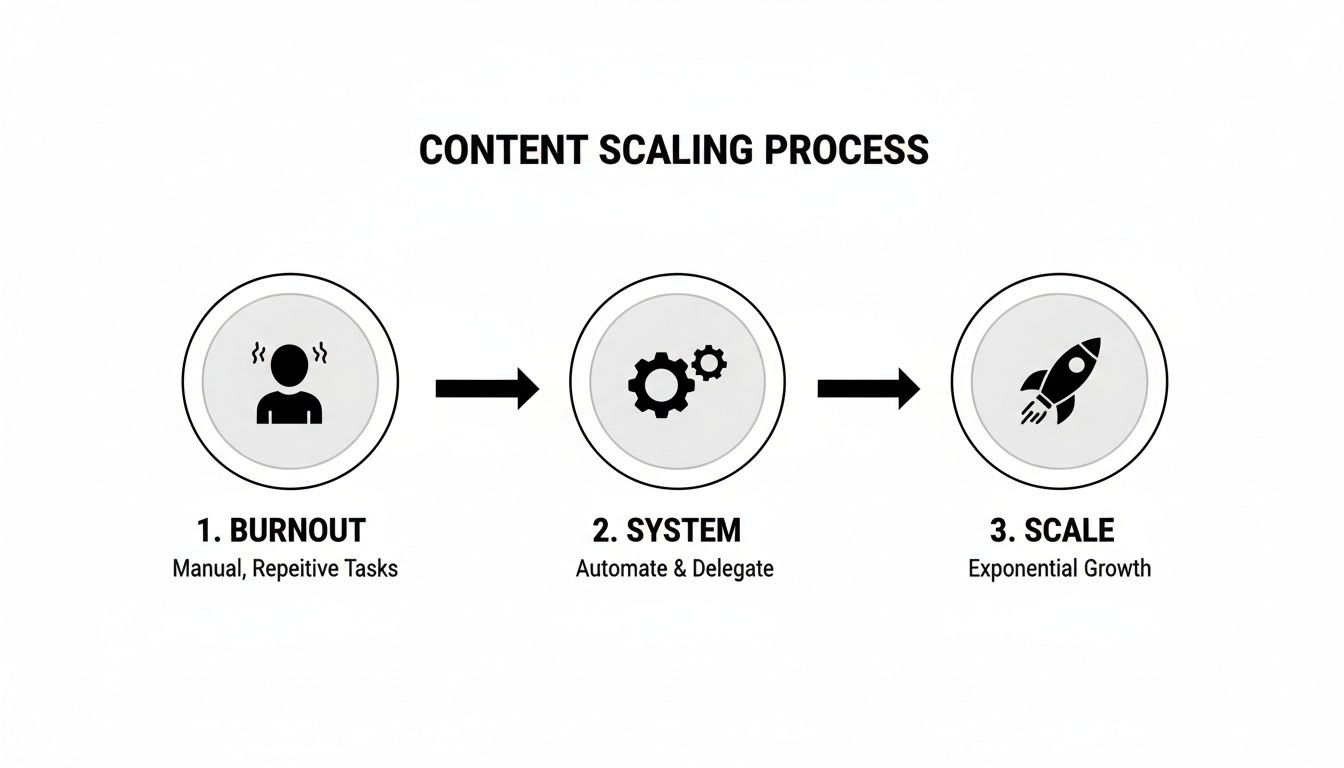
As you can see, you don't get exponential output through sheer force of will. You get it by bridging the gap between burnout and growth with a solid, repeatable process.
Systemizing Your Content Ideation
Let’s be honest, the biggest bottleneck for most creators isn’t the actual work—it’s the paralyzing feeling of staring at a blank calendar and wondering what to create next.
To fix this, you have to stop waiting for inspiration to strike and start hunting for ideas with a plan. A systematic approach to ideation means you’ll always have a pipeline of validated topics ready to go.
Keyword Clustering: Don't just find single keywords. Group related ones around a central theme. For a photographer, a cluster might be "newborn photography poses," with sub-topics like "safe newborn poses," "newborn props," and "posing with parents." Suddenly, one big idea becomes five or six concrete pieces of content.
Social Listening: Your audience is telling you what they want every single day. Jump into Reddit threads, Quora questions, and niche Facebook groups. What problems are people trying to solve? What questions keep coming up? Those are your next content ideas, served up on a silver platter.
The goal is to make ideation a scheduled, data-driven task, not a moment of random inspiration. Block out a few hours each month to fill your idea bank, and you'll never stare at a blank page again.
The Power of Batching and Content Atoms
Once your ideas are flowing, it’s time to get efficient with production. This is where two game-changing concepts come into play: content batching and "Content Atoms." Both are designed to squeeze every last drop of value out of your creative efforts.
Content batching is simple but revolutionary. You dedicate specific blocks of time to similar tasks. Instead of trying to write, shoot, and edit a single piece of content from start to finish, you group all the writing together, all the filming together, and all the editing together.
For example, a creator might spend Monday scripting a month's worth of videos, Tuesday filming them all, and Wednesday editing. This approach cuts down on context switching, which is a massive productivity killer. You stay in the same mental "zone" and just get more done, faster.
A Content Atom is a core piece of pillar content that you intentionally design for maximum repurposing from the very beginning. Think of it as the central sun of your content solar system, with dozens of smaller assets (posts, clips, quotes) orbiting it.
Let's say a product photographer’s Content Atom is a comprehensive photoshoot for a new product line. That single session is planned to produce a whole suite of assets:
- Primary Assets: High-resolution product images for the Shopify store.
- Secondary Assets: A gallery of lifestyle shots for social media feeds and ads.
- Micro-Content: Behind-the-scenes video clips perfect for Instagram Reels or TikTok.
- Supporting Content: A few new professional headshots of the founder holding the product.
One production day can easily yield dozens of unique pieces of content. For marketers needing to scale ad creative, this is huge. You can even use a UGC video generator to quickly produce a high volume of assets that have that authentic, user-submitted feel.
To give you a clearer picture of how this works in practice, here is a template you can adapt for your own workflow.
Example Weekly Content Batching Schedule
This schedule shows how a solo creator or small team can realistically produce a month's worth of core content in a single focused week.
| Day | Focus | Tasks | Tools Used |
|---|---|---|---|
| Monday | Strategy & Ideation | Review analytics, research keywords, finalize topics for the month, write all scripts/outlines. | Google Analytics, Ahrefs, Notion |
| Tuesday | Video & Photo Production | Film all primary video content (e.g., YouTube videos), conduct one large photoshoot. | DSLR Camera, Lighting Kit, Teleprompter App |
| Wednesday | Audio & Core Editing | Record voiceovers, edit all primary long-form videos, pull audio for podcast episodes. | Adobe Premiere Pro, Audacity |
| Thursday | Repurposing & Micro-Content | Create short clips for Reels/TikTok, design quote graphics, write social media captions, draft blog posts. | CapCut, Canva, Agorapulse |
| Friday | Scheduling & Distribution | Schedule all social posts, upload videos to YouTube/Vimeo, prepare email newsletters, review everything. | Buffer, Mailchimp, ClickUp |
By the end of the week, your content for the next 3-4 weeks is done, scheduled, and ready to go. This frees you up to focus on engagement, community management, and other parts of your business without the constant pressure of "what am I posting today?"
Using AI as Your Creative Force Multiplier
Let's be real about artificial intelligence. Forget the buzzwords and sci-fi hype—AI is one of the most practical tools you can add to your content creation toolkit. When you start weaving it into your workflow, you aren't replacing your creative spark. You're giving it a massive boost by offloading the repetitive, soul-crushing tasks that eat up your time and energy.
This is about working smarter, not harder. It means you get to spend more of your day on big-picture strategy and creative direction, which is where your brand's unique voice actually comes from. Think of AI as the most dedicated production assistant you've ever had, ready to execute your vision 24/7.
The numbers don't lie. The market for AI-powered content creation is exploding, rocketing from USD 2.29 billion in 2024 to a projected USD 12.9 billion by 2035. Why the massive jump? Because generative AI makes high-level personalization and efficiency accessible to everyone, creating visuals that can hook an audience 2-3x better than your standard stock photo.
From Static to Dynamic Content in Minutes
One of the quickest wins you'll get from AI is its knack for breathing new life into old assets. That static graphic you designed last quarter? The one that got a few likes and then disappeared into the social media void? With a few clicks, it can become a dynamic, scroll-stopping video.
Let's say you have a great product shot. Instead of just posting it as-is, you can feed it into an AI tool and instantly:
- Animate specific elements to catch the viewer's eye.
- Add slick, dynamic text overlays to tell a quick story.
- Generate a looping video clip, perfect for Instagram Reels or TikTok.
You don't need a degree in video editing, either. The best new AI platforms are built for creators, marketers, and photographers—not just visual effects artists. The process is surprisingly intuitive.

This simple capability means you can effectively double or triple your content output without a single new photoshoot, just by remixing what you already have.
Real-World Scenarios for Exponential Output
Theory is great, but let's talk about what this actually looks like in practice.
For the E-commerce Brand:
Imagine you sell handcrafted jewelry. Instead of dropping thousands on a lifestyle shoot, you can use AI to generate an endless stream of on-model shots. Show your pieces on a diverse range of models, in any setting you can dream up—a cafe in Paris, a beach in Bali, a bustling city street—all without booking a single flight.
For the Consultant or Coach:
A business coach needs a polished, consistent look across LinkedIn, their website, and speaking engagement flyers. Forget that one static headshot. AI can generate a whole portfolio of professional images: a sharp, corporate look for LinkedIn, a warmer, more approachable version for their "About Me" page, and a casual style for Twitter. It's brand cohesion on demand. You can also check out our AI professional headshots.
By automating the creation of visual variations, AI lets you maintain a high-quality, professional image at scale. This frees up both your budget and your time for what really matters: client work and growing your business.
Want to take it a step further? You can leverage AI to create viral faceless content, a clever strategy that removes the need for on-camera talent altogether.
Building Your Own Virtual Talent Pool
Here’s where it gets really powerful. One of the biggest headaches in visual content is sourcing and managing human talent—models, influencers, even just consistent-looking team members. AI solves this.
Instead of juggling contracts, schedules, and usage rights, you can create your own digital brand ambassador. With an AI influencer generator, you can design a virtual person who is the perfect embodiment of your brand's aesthetic.
This "person" can then be placed into any scene, wearing any product, giving you complete creative control. You get a consistent, recognizable face for your brand across every campaign, from social ads to website banners, without any of the logistical nightmares of working with real people. It’s a truly scalable solution for modern visual marketing.
Structuring Your Team for Scale
Great tools and slick workflows will only get you so far. At the end of the day, scaling your content comes down to people. If you don't have the right team structure in place, even the most brilliant system will eventually crack under the pressure.
The goal isn't just to hire more bodies; it's about arranging your talent—whether in-house or outsourced—to maximize everyone's strengths and keep the content engine running smoothly. There's no one-size-fits-all answer here. The best model for you hinges on your budget, your goals, and just how complex your content really is. You can also check out our AI dating profile photos.
Let's walk through three proven structures that work, whether you're a one-person show or running an entire creative department.
The Solo Creator Powerhouse
Flying solo doesn't mean doing it all yourself. This model is about being the strategic brain of the operation and then using a smart mix of tech and freelancers to multiply your output. You become the creative director, setting the vision, and then delegate the execution.
This is the go-to approach for entrepreneurs, influencers, and small business owners trying to stay lean. You hang onto the high-value stuff—strategy, being on camera, engaging with your audience—and offload the tasks that eat up your time.
Common tasks to hand off in this model:
- Video Editing: Someone has to turn all that raw footage into a polished, watchable story. This is almost always the first thing to outsource.
- Graphic Design: Think social media templates, YouTube thumbnails, and quote cards. A good designer can create a bank of these for you to pull from.
- Copywriting: You provide the core ideas in a detailed brief, and a writer turns them into finished blog posts or snappy social captions.
For this to work, you have to master the art of the creative brief. A well-documented process is your best friend, ensuring any freelancer can jump in and nail the brand voice without endless back-and-forth.
The Lean In-House Team
Once your content needs start to stabilize and you require more consistency, it’s time to bring some key roles inside. A lean in-house team is a small, scrappy group of multi-talented people who each own a piece of the content assembly line.
The biggest win here? Deep brand knowledge and speed. Everyone's in the same (virtual) room, so feedback loops are tight, ideas flow faster, and keeping the brand voice consistent becomes second nature.
A typical lean team might look like this:
- Content Strategist: The person staring at the chessboard, figuring out the next move. They handle the content calendar, SEO, and tracking what's working.
- Production Lead: This is your hands-on creator. They're the ones actually shooting the photos, filming the videos, or writing the cornerstone articles.
- Community Manager / Distributor: They take the finished content and make sure the right people see it on the right platforms, sparking conversation and driving traffic.
This model is brutally efficient because there’s very little role overlap. Everyone knows their job, which cuts down on confusion and wasted effort.
The Hybrid Model: Blending In-House and Outsourced Talent
For most growing brands, this is the endgame. The hybrid model gives you the best of both worlds: a core in-house team for strategy and brand integrity, backed by a flexible network of specialized freelancers or agencies for execution.
Your internal people steer the ship. They set the strategy, manage the calendar, and handle the most critical brand moments. But when it's time to produce a complex animated video, record a professional voiceover, or draft a highly technical whitepaper, they tap into a network of outside experts. You get access to an incredible talent pool without the overhead of full-time salaries.
The explosion of cloud-based collaboration tools has made this model more viable than ever. Since 2020, the market for this kind of work is projected to grow at a 9.5% CAGR from 2025-2033. For creative teams using platforms like PhotoAI Studio, features like the Background Remover or Avatar Generator mean a designer in Berlin can work seamlessly with a strategist in New York. It's no surprise that 77% of companies with a centralized content strategy report a significant ROI. You can read more about these trends in digital content creation.
This structure is incredibly agile. You can spin up production for a major product launch by bringing on a few extra video editors for a month, then scale back down to just your core team during quieter periods. It all hinges on smart delegation and, once again, crystal-clear creative briefs to keep everyone aligned.
Maintaining Quality Control at Scale
Let’s be honest. Scaling up content creation brings a nagging fear to the surface for every creator and marketer: will the quality inevitably tank? It's a valid concern. When you increase volume and start bringing more people into the mix—writers, designers, VAs—it's easy for that special something, your brand's unique voice and visual flair, to get watered down.
But here’s the good news: maintaining high standards isn’t about luck. It’s about building deliberate, repeatable systems. Quality control at scale is a direct result of crystal-clear documentation and structured feedback, turning your brand standards from a vague idea into an actionable, daily practice.

Create a Comprehensive Brand Style Guide
Your first and best line of defense against inconsistency is a rock-solid brand style guide. This isn’t just a page with your logo and hex codes. Think of it as the constitution for your content—the single source of truth for your brand’s entire personality. It needs to be so clear that a freelancer you hired yesterday can produce work that feels just as authentic as something you’d create yourself.
Your guide has to go deep and cover a few key areas:
- Tone of Voice: Are you witty and informal, or authoritative and professional? Go beyond adjectives. Include specific examples of words to use and, just as importantly, words to avoid. A playful brand might have a rule like, "Use 'awesome' and 'super,' but please, never say 'synergy' or 'utilize.'"
- Visual Aesthetics: Detail everything. For photographers, this means specifying acceptable lighting conditions, go-to post-processing presets, or even camera settings. For marketers, it could be rules on photo editing styles, filter usage, typography, and graphic composition.
- Formatting Rules: This might seem minor, but it’s huge for brand recognition. Outline exactly how you handle headlines, subheadings, bullet points, and calls-to-action. Consistent formatting makes your content instantly familiar and way easier for your audience to digest.
This guide eliminates guesswork. It dramatically speeds up onboarding and empowers every single contributor, whether they're in-house or halfway across the world, to create with confidence.
Implement a Content Quality Checklist
While a style guide tells people how to create, a checklist ensures they actually did it. Before any piece of content sees the light of day, it must pass through a final quality gate. This isn't about micromanaging or nitpicking; it's a systematic review to catch errors and confirm every asset is perfectly aligned with your strategic goals.
This simple tool is your pre-flight check before launch. It prevents sloppy mistakes and ensures every single post, video, or image is working as hard as it can for your brand.
Quality at scale isn't an accident. It's the predictable outcome of well-designed systems and an unwavering commitment to your brand's core identity.
Here’s a simple checklist template you can borrow and adapt for your own team. It’s a great starting point for making sure nothing slips through the cracks.
Content Quality Control Checklist
| Checklist Item | Yes/No | Notes |
|---|---|---|
| Does it align with our core message? | Example: Does this photo reinforce our "adventure" theme? | |
| Is the tone of voice consistent with our guide? | ||
| Are all visuals high-resolution and on-brand? | Checked for proper filters, cropping, and style. | |
| Is the primary call-to-action clear and unambiguous? | ||
| Has it been proofread for spelling and grammar? | Read aloud to catch awkward phrasing. | |
| Are all links working and directed correctly? |
Using a checklist like this turns an abstract goal ("make good content") into a concrete, verifiable process that anyone can follow.
Establish Effective Feedback Loops
Finally, great content is almost never created in a vacuum. A structured feedback process is absolutely essential for continuous improvement, especially when you’re managing a distributed team of freelancers and employees.
- Peer Reviews: For your in-house team, a simple peer review system can be a game-changer. Just have one creator review a colleague’s work against the checklist before it moves up for final approval. This not only catches issues early but also fosters a culture of collaboration and shared ownership.
- Structured Revisions: When you're working with freelancers, be upfront about your revision process. Clearly state how many rounds of revisions are included in the scope and what kind of feedback they can expect. Using a project management tool like Asana or Trello to track comments keeps everything organized, transparent, and professional.
These loops do more than just polish a single piece of content. Over time, they train your entire creative ecosystem, constantly reinforcing your brand standards and elevating everyone’s work.
How to Measure and Optimize Your Content Engine
Building a content engine isn't a "set it and forget it" project. It's a living system, and if you aren't constantly tuning it, it's going to stall out. You have to feed it the right data—and I don't just mean gut feelings or vanity metrics.
This is where the pros separate themselves. They treat their content production like an assembly line, constantly looking for bottlenecks and ways to make the whole process smoother, faster, and more powerful. It’s about moving beyond just looking at likes and shares and getting under the hood to see how the machine is really running.
Moving Beyond Vanity Metrics
First things first, you need to start tracking KPIs that actually reflect the health of your production process. Business goals like leads and conversions are the end game, of course, but your operational metrics tell you if your system is even capable of getting you there consistently.
Think of these as the diagnostic tools for your content engine. Here are a few that I find incredibly revealing:
Content Velocity: This is the big one. How long does it take for a brilliant idea to actually become a published piece of content? If a simple blog post is taking six weeks to go from concept to live, you’ve got a serious clog in the system. A shorter velocity means you're agile and can jump on opportunities fast.
Asset Utilization Rate: How many times are you successfully repurposing a single core asset? Are you turning that one webinar into 10 social clips, 3 blog posts, and a quote graphic? This number tells you if you're truly maximizing your effort or just creating one-off pieces that die after a week. A high utilization rate is a huge win.
Production Cost Per Asset: Get real about what it costs—in both time and money—to create something. Track the hours, the software costs, the freelancer fees. This isn't about being cheap; it's about understanding your true ROI and making smarter calls on what to create in-house versus what to outsource.
When you focus on these numbers, you stop guessing and start diagnosing. You can see exactly where the friction is—maybe it’s a painfully slow approval process or a clunky handoff between your writer and designer—and you can fix it.
Connecting Process to Performance
Okay, so you've got your operational dashboard humming along. The final, crucial step is to connect those internal numbers back to your actual business goals. This is where the magic happens.
For instance, you might run the numbers and discover that content with a high Asset Utilization Rate—the stuff you're repurposing like crazy—also happens to generate the most qualified leads. Boom. That's not just a hunch anymore; it's a data-backed insight. It tells you that your repurposing strategy isn't just efficient, it's incredibly effective at moving the needle.
This connection validates your entire scaling strategy. You can confidently prove that a faster, more efficient content machine directly contributes to bottom-line growth. By checking in on this data regularly, you can double down on what’s working and ruthlessly cut what isn't, creating a self-improving system that fuels real, sustainable growth.
Common Questions on Scaling Content
When you start talking about scaling up content, a few key questions always pop up. Let's tackle them head-on, moving past the theory and into what actually works when the rubber meets the road.
How Can I Scale Content Creation Without a Huge Budget?
This is the classic creator's dilemma. The answer isn't about finding more money; it's about being smarter with the resources you already have.
Start by ruthlessly batching your content. Dedicate entire days to one type of task—filming, writing, or designing. You'll be amazed how much you get done when you're not constantly switching gears. Then, get obsessed with repurposing. That one core video idea? It’s also a blog post, five social media clips, a handful of quote graphics, and a section in your next email newsletter.
Lean into cost-effective AI tools that use a credit system. Instead of paying for a full-blown photoshoot, you can generate an entire library of professional visuals for a fraction of the cost.
At What Point Should I Start Outsourcing?
You bring in help the moment a specific task becomes a consistent bottleneck or it's something you genuinely dread doing. Don't wait until you're completely overwhelmed.
The first things to go are usually the technical, time-sucking jobs that aren't your core strength. Think video editing, complex graphic design, or audio mixing.
Here's a good rule of thumb: if you're spending more than 20% of your work time on a task you're not an expert in, you're losing money. Hiring a specialist for that one thing frees you up to focus on strategy and the creative vision only you can provide.
The real magic happens when you guide AI with your unique creative vision. Let AI handle 80% of the repetitive production work. This gives you back the time to obsess over the 20% that makes your brand stand out.
Will Using AI Make My Content Look Generic and Soulless?
Only if you treat it like a magic button instead of a powerful assistant. AI content becomes generic when it's used without strategy or a clear brand voice.
The key is to use features that allow for deep customization. Train the AI on your existing brand assets, your color palettes, and your style guides. The goal isn't for the AI to replace your creativity, but to execute your creative direction at scale, ensuring every piece of content feels like it came directly from you.
Ready to multiply your creative output without multiplying your budget? With Photo AI Studio, you can generate an endless stream of professional-quality images, headshots, and videos in minutes. See how it works.


