
Let's cut through the jargon. At its heart, synthetic media is any kind of digital content—an image, a video clip, a voice recording, or even text—that’s been created or tweaked by artificial intelligence.
Instead of a photographer capturing a real moment or a microphone recording a real voice, an AI generates the content from the ground up, using data and specific instructions as its creative brief.
Understanding Synthetic Media and Why It’s Suddenly Everywhere
Picture a professional headshot of a person who doesn't exist. Or a full-blown product photoshoot that never saw the inside of a studio. How about a marketing video starring a spokesperson who is entirely computer-generated? This isn't some far-off future; it's synthetic media, and it's happening right now. You can also check out our AI professional headshots.
Think of the technology as a digital artist that has spent years studying millions of real-world examples. When you ask it to create a photo, it doesn't just search for an existing picture online. It constructs a brand new one, pixel by pixel, based on its deep understanding of what makes an image look authentic and professional. This completely changes the game for creativity and efficiency.
Why This is a Big Deal for Business
The buzz around synthetic media isn’t just about cool new tech—it represents a fundamental shift in how we create content, and the business implications are massive. AI tools are now so accessible that anyone, from a solo e-commerce entrepreneur to a global marketing agency, can produce stunning, high-quality visuals without the usual costs, headaches, and logistical nightmares of traditional photoshoots.
This is leveling the playing field, and businesses are catching on fast.
Synthetic media is no longer a niche experiment. It's a powerful economic engine, reshaping how entire industries think about content creation. The global market, already valued at over USD 5 billion, is proof of its real-world impact.
This explosive growth is all about practical value. Businesses can now generate a nearly infinite number of ad variations to see what works best. Creators can build entire virtual worlds from their laptops. And you can get that perfect LinkedIn photo without ever needing to book a photographer.
The numbers don't lie. The market is projected to skyrocket to almost USD 22 billion by 2033, a clear sign of just how deeply this technology will be woven into our digital lives. You can dig into the full market projections to see just how fast it’s scaling.
How AI Learns to Create Synthetic Media
To really get what synthetic media is, you have to peek under the hood at the AI models doing the work. These aren't just clever computer programs. They're complex systems trained to understand and recreate the tiny details of the real world—think of them as digital apprentices that have studied millions of examples to master the art of creation.
At the heart of all this are two major breakthroughs: Generative Adversarial Networks (GANs) and Diffusion Models. The names sound intimidating, I know, but the ideas are surprisingly straightforward. Understanding them is the key to seeing how a simple text prompt can magically become a photorealistic headshot. You can also check out our AI dating profile photos.
The Artist and the Critic Duo
One of the foundational technologies is the Generative Adversarial Network, or GAN. The easiest way to picture it is a creative duo made up of an artist and a critic—both of them are AIs.
- The Generator (The Artist): This AI's whole job is to create new images from scratch. At first, its attempts are a mess—clumsy, unrealistic, like a beginner’s first sketches.
- The Discriminator (The Critic): This second AI only does one thing: it looks at images, both real ones from a training library and the fakes from the Generator, and decides if they're authentic or not.
These two are locked in a constant battle of wits. The artist makes an image, the critic calls it out as fake, and the artist goes back to the drawing board to try again. This happens millions of times, and both AIs get smarter with every single round.
Eventually, the artist gets so good that its creations can consistently fool the critic. It’s this relentless feedback loop that produces the mind-blowingly realistic images we see today.
The Sculptor in a Block of Marble
A newer, incredibly powerful approach is the Diffusion Model. If a GAN is like an artist and a critic, a diffusion model is more like a sculptor. It doesn’t start with a blank canvas but with a block of pure noise—picture the static on an old TV screen.
From that chaotic mess, the AI begins a meticulous process of chipping away. It has been trained to see patterns in the noise and slowly, step-by-step, it removes the randomness until a clear, coherent image emerges. It’s like a sculptor who sees a statue inside a block of marble and just needs to remove everything that isn't the final piece.
This method gives the AI an amazing level of detail and control, which is why it’s become the engine behind so many popular AI image generators. The concept map below gives you a good visual of how these AI "brains" connect to different kinds of media.
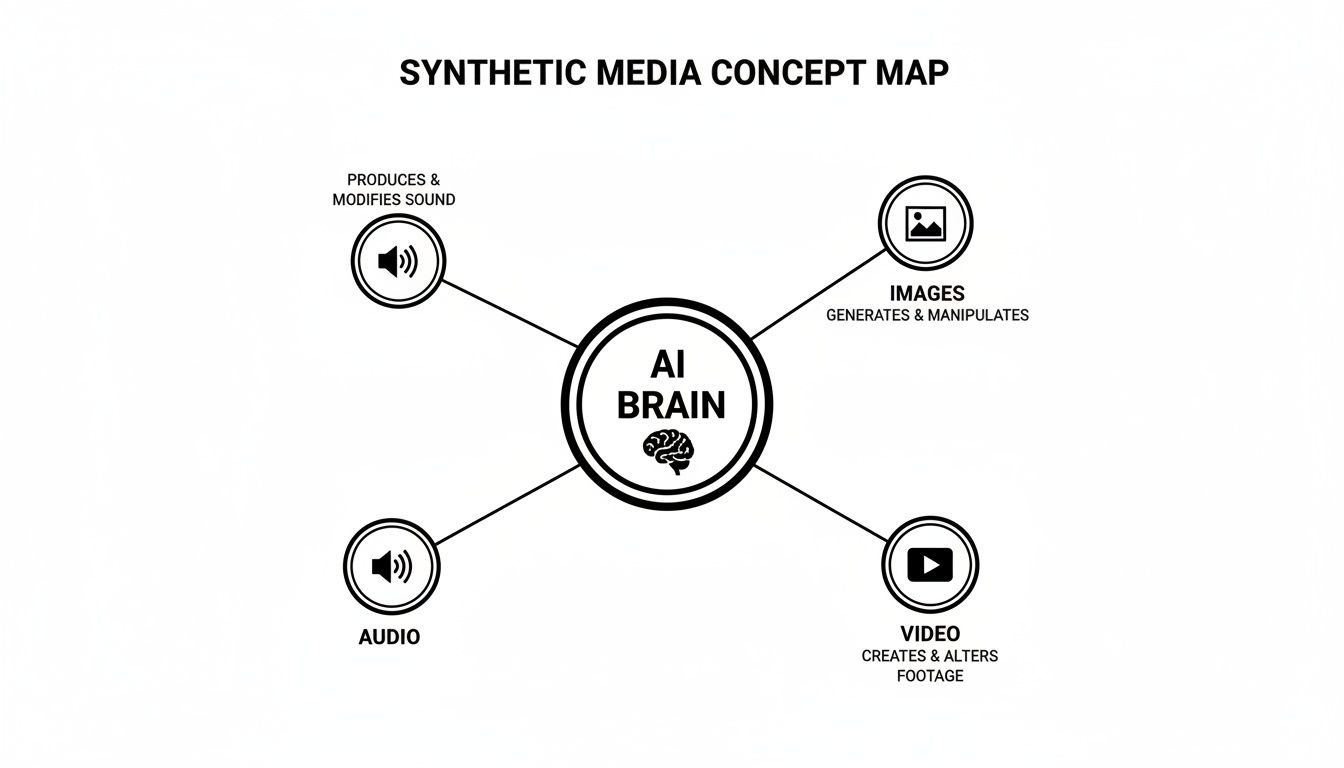
As you can see, a central AI engine is the source for generating and manipulating images, video, and audio—the core building blocks of synthetic media. This shows that these technologies aren't just one-trick ponies; they are versatile creative tools that can be applied across different formats to produce a huge range of AI-generated content.
Real-World Examples Are Already Here
The theory behind synthetic media is fascinating, but let's be honest—what really matters is how it solves real problems for actual businesses. Forget the complex models for a second. Let's look at where AI-generated content is already saving people time, cutting serious costs, and opening up creative avenues that were once unthinkable.
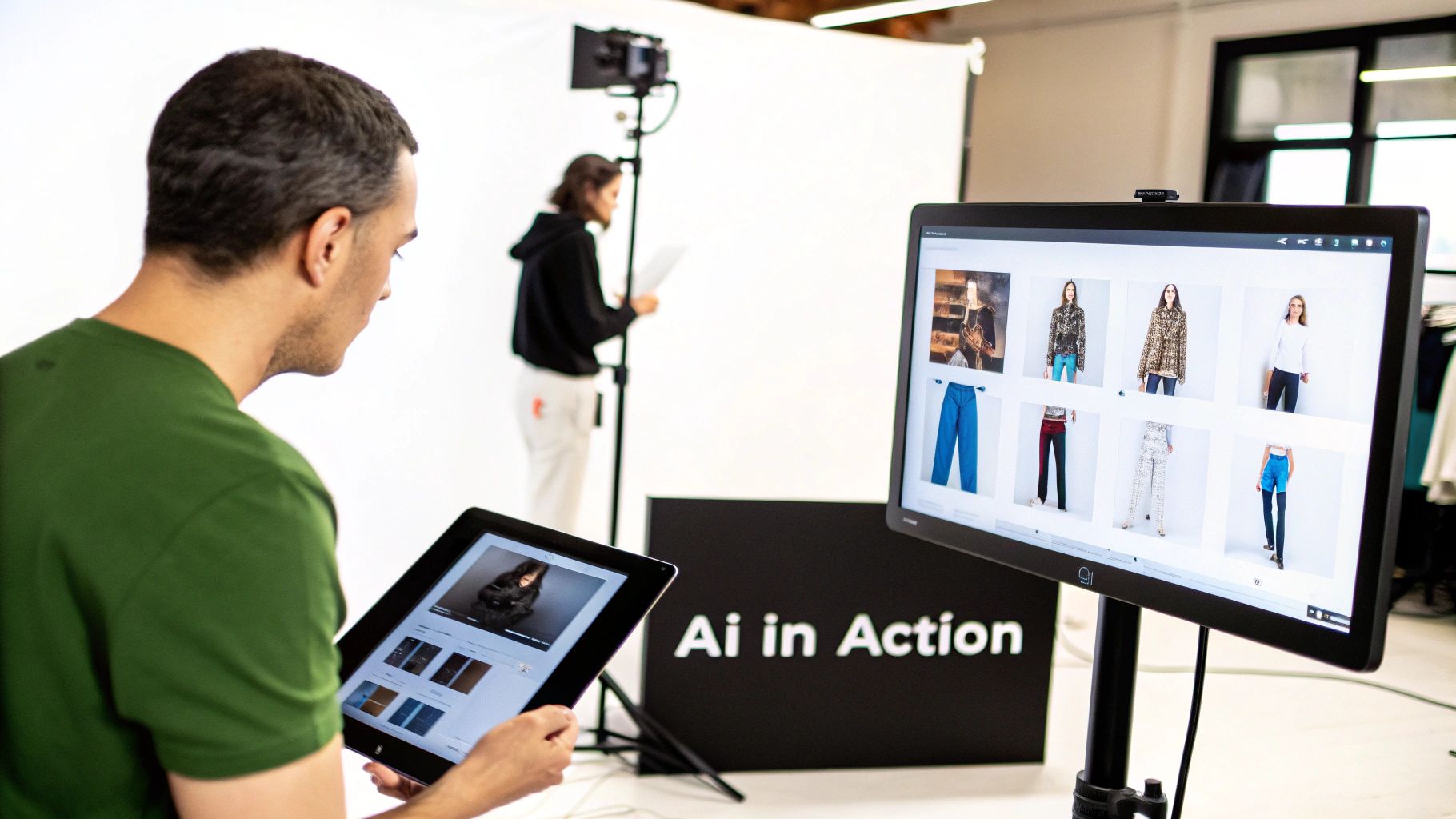
Picture an e-commerce fashion brand gearing up for a new season. The old way was a logistical nightmare: booking models, photographers, and stylists, securing expensive studios, and wrangling it all for weeks. The final bill? Tens of thousands of dollars for a handful of photos.
Virtual Photoshoots and the New E-commerce Playbook
Now, let’s run that same scenario with synthetic media. That brand can generate an entire on-model photoshoot without ever touching a camera. They just upload flat shots of their clothing, and the AI renders them on a diverse lineup of hyper-realistic models—any ethnicity, age, or body type they need. This isn't just about saving a buck; it's a massive strategic shift.
- Slash Production Costs: A virtual shoot costs a tiny fraction of a traditional one. We're talking orders of magnitude cheaper.
- Move at Lightning Speed: Forget waiting weeks. Brands can pump out hundreds of unique product images in a single afternoon.
- Unlock Hyper-Personalization: Imagine creating ad campaigns with models who look exactly like your target audience in different cities. Now you can, testing what resonates and doubling down on what works.
This completely levels the playing field, allowing smaller brands to compete with the visual firepower of retail giants. It’s particularly powerful for generating top-tier visuals, and if you want to go deeper on this, there are great guides on AI product photography.
A New Era for Marketing and Content Creation
Marketing and entertainment are ground zero for this explosion. AI video generators and digital avatars are quickly becoming standard tools, not novelties. The numbers don't lie: the market is set to jump from USD 4.9 billion in 2025 to a staggering USD 26.2 billion by 2033. That's a 23.20% growth rate, fueled by practical uses like creating authentic-looking UGC-style ads without ever hiring an actor. It’s a total game-changer for campaign agility.
Then you have the incredible rise of AI influencers.
Think about it. Instead of paying a massive fee for a single post from a human influencer, a brand can literally create its own perfect ambassador from scratch.
This virtual personality is always on-brand, available 24/7, and can star in endless campaigns across any platform. They offer a level of creative control and consistency that’s simply impossible to get from a human partner. It's a wild concept, but tools like an AI influencer generator are making it a reality right now.
These examples prove synthetic media isn't some far-off sci-fi concept. It’s here, and it’s already delivering powerful business results today.
The Strategic Business Benefits of Synthetic Media
Beyond the mind-bending technology, the real story here is what synthetic media does for the bottom line. Businesses aren't just adopting these tools because they're cool; they're doing it for a clear competitive edge, driven by measurable returns.
It all boils down to making content creation faster, cheaper, and a whole lot smarter.
The most immediate win? A massive drop in costs. A traditional photoshoot for a new clothing line can easily run over $5,000 once you factor in models, location scouts, photographers, and editors. By contrast, an AI platform can crank out an entire campaign's worth of stunning visuals for less than the cost of a fancy dinner. It completely changes the economics of marketing.
This new math is fueling explosive growth. The synthetic media market is on track to hit USD 7.23 billion in 2025 and is projected to more than double to USD 15.01 billion by 2030. A huge slice of that pie—a whopping 42.48%—belongs to generative AI, which is letting even small businesses slash their visual production costs by 50-70%. You can dig into the numbers and market drivers over at Mordor Intelligence.
Unlocking Unprecedented Scale and Speed
Speed is the other game-changer. Forget spending weeks planning, shooting, and editing a single video ad. Now, a marketing team can generate and test hundreds of different versions in a few hours. This means you can rapidly A/B test different models, messages, and calls to action to find out what actually works with your audience, not just what you think will work.
And this isn't just for ads. This kind of scalability applies to any visual a business could possibly need.
- Product Catalogs: Need to show your new handbag on 1,000 different backgrounds? No problem. Generate them all without ever booking a studio.
- Social Media Content: Create a month's worth of diverse, high-quality images in a single afternoon. Seriously.
- Professional Headshots: Get your entire global team on the same page with consistent, high-end headshots created instantly. If you want to see this in action, try out a free professional headshot generator for yourself.
Fueling Creative Freedom and Personalization
Synthetic media also demolishes the creative walls built by budgets and logistics. Brands can finally experiment with those wild, imaginative concepts that were always too expensive or physically impossible to shoot. This freedom to test and iterate without risk leads directly to more interesting and effective campaigns.
By removing the friction of traditional content creation, synthetic media empowers businesses to personalize customer experiences at a scale never before possible.
Imagine tailoring your marketing to specific demographics by showing your products on models that actually look like the people you're trying to reach in that region. This isn't just a gimmick; it's about creating a genuine connection. It turns a generic ad into a relevant, personal message that boosts engagement and builds loyalty. This is no longer just a neat trick—it's a core business strategy.
Navigating the Ethical and Legal Landscape
The creative power of synthetic media is undeniable, but it's a tool, and like any powerful tool, it forces us to ask some tough questions. We're standing at a fascinating and critical junction where incredible opportunity meets significant ethical and legal responsibility. The impact of this technology comes down to one thing: how we choose to use it.
The elephant in the room is, of course, the potential for misinformation using deepfakes. We've all seen or heard about them—hyper-realistic videos or audio clips that make it look and sound like someone said or did something they never did. The stakes here are incredibly high, touching everything from personal reputations to public trust and even political stability. This has kicked off a much-needed global conversation about what "real" even means online.
The Evolving Rules of AI Content
Beyond the obvious threat of deepfakes, the legal world is in a mad dash to catch up. Right now, courts and governments are grappling with fundamental questions that didn't exist a few years ago.
- Copyright and Ownership: This is a big one. Who actually owns an AI-generated image? Is it the person who typed the prompt? The company that built the AI model? Or does no one own it? As it stands, the law is murky, but current thinking suggests purely AI-generated works might not get traditional copyright protection. This is changing fast, so watch this space.
- Data Privacy: How do these AI models get so smart? They're trained on massive datasets of images and text. But if your personal photos were used to train a model without your permission, that’s a huge privacy violation. This is why responsible platforms are built on ethically sourced data and are transparent about how they handle your information.
- Likeness and Identity: The ability to perfectly replicate a person's voice or face opens a whole new can of worms. We're already seeing new laws emerge to tackle this, like Tennessee's ELVIS Act, which was designed to protect musicians from having their voices cloned by AI without consent. It's just the beginning of a new wave of legislation.
The real challenge is that synthetic media erases the line between what’s real and what’s artificial. It fundamentally tests our ability to verify information and trust what we see, demanding a new level of critical thinking from everyone.
Building Guardrails for a New Technology
In response, a multi-front effort is underway to make sure this technology is used safely and ethically. On one side, responsible platforms are getting ahead of the problem by creating strong policies to ban harmful or deceptive content. You can see how we approach this by reading our own content moderation policy.
On the other side, researchers are developing clever ways to detect AI-generated media, like digital watermarking that embeds a hidden signature into a file to prove its origin. To get a better sense of how platforms can be held accountable, it's worth looking at frameworks like these AI video moderation guidelines.
The goal isn't to stop progress, but to build a system where we can enjoy the incredible benefits of synthetic media while keeping the potential for abuse in check. It’s all about creating an ecosystem built on transparency and trust.
A Framework for Using Synthetic Media Responsibly

Jumping into the world of synthetic media is incredibly exciting, but its creative power comes with a responsibility. Building a framework for using this tech responsibly isn't just about dodging legal bullets; it’s about earning and keeping the trust of your audience. When you get this right, you help create a sustainable, positive future for the technology.
The cornerstone of this framework is transparency. Not every AI-generated image needs a giant disclaimer, but you absolutely have to disclose AI involvement when the context demands it. Think journalism, customer testimonials, or any image meant to represent a real person. A simple disclosure prevents deception and keeps your credibility intact.
Just as critical is a deep respect for consent and ownership. You should only ever use source images or train models with photos you have the explicit legal right to use. Sticking to this simple rule protects people’s privacy and keeps your work on solid legal ground.
A Practical Checklist for Ethical Creation
Think of this as a quick pre-flight check before you hit "generate." It’s a simple way to ensure you’re not just creating something visually stunning, but also something you can stand behind, both ethically and legally. A solid starting point is to confirm these three things:
- You Have the Rights: Do you personally own or have a clear license for any source photos you're using to create new content?
- You Understand the Terms: Have you actually read the platform’s commercial licensing agreement to make sure what you want to do is allowed?
- You Are Being Transparent: Is there any chance your audience could be misled by this content? If so, have you added a clear and easy-to-find disclosure?
Platforms like Photo AI Studio are built to make these responsibilities easier to manage. We provide straightforward terms of service, strong data privacy policies, and grant clear commercial licenses for the content you generate. This way, you can pour your energy into being creative while we handle the ethical groundwork. This kind of shared responsibility is the key to letting synthetic media grow in a healthy, trustworthy way.
Frequently Asked questions
Is It Legal to Use Synthetic Media for Marketing?
Yes, for the most part, it is. Using synthetic media in your marketing is generally legal, but it lives in the same world as regular content—you have to respect copyright and privacy laws.
The biggest legal hurdle is the input. You must have the legal right to use the photos you upload to train the AI. Reputable platforms will grant you a commercial license for the final images you generate, but the responsibility for the photos you start with is all yours. A good rule of thumb: if you don’t have the rights to a photo, don't upload it.
And, of course, be transparent. If you’re using AI content in a way that could mislead someone, like for an endorsement or a customer testimonial, you need to be upfront about it.
How Is a Deepfake Different From Other Synthetic Media?
Think of "synthetic media" as the entire category of AI-generated content. "Deepfake" is a very specific, and often notorious, sub-category within it.
A deepfake specifically refers to media, usually a video, where one person’s face is swapped onto another’s body so convincingly that it’s hard to tell it’s fake. Because this technique has been used for misinformation and malicious purposes, the term now carries a lot of negative weight.
But synthetic media is so much broader. It covers everything from the AI headshots you see on LinkedIn and AI-generated product photos to computer-generated voiceovers. Most of this work isn’t about tricking anyone; it's about creating useful or artistic content efficiently.
Can I Own the Copyright to Images I Generate With AI?
This is where things get a bit murky, as the law is still catching up to the technology. In the U.S. and many other places, work created entirely by an AI without significant human creative input often can't be copyrighted in the traditional sense.
But don't let that scare you off. The lack of direct copyright ownership doesn't mean you can't use the images for your business. Platforms like Photo AI Studio solve this by granting you a full commercial license. This license is your legal key to using the images for marketing, on your website, in social media—anywhere your business needs them.
Ready to create stunning, high-quality visuals for your business in minutes? See what Photo AI Studio can do for you and start generating professional photos today at https://photoaistudio.com.