

Picture a fitting room you can access from your couch, your office, or a coffee shop. That's the simple promise of virtual try-on (VTO) technology. At its core, it's a clever mix of augmented reality (AR), artificial intelligence (AI), and computer vision that digitally drapes products—like a new jacket or a shade of lipstick—onto your photo or live video. The whole point is to finally take the guesswork out of online shopping.
Bringing the Fitting Room to Your Screen
Virtual try-on tech is all about closing the gap between scrolling through a website and actually holding a product in a store. It’s not just about seeing a shirt on a perfectly-proportioned model; it’s about seeing how that shirt hangs on your shoulders.
This creates a personal, hands-on shopping experience that was pretty much science fiction just a few years ago. For shoppers, it’s a huge confidence booster. You get a much better feel for an item, which cuts down on that all-too-common disappointment when your order arrives and looks nothing like it did online.
For brands, especially those fighting for attention in the crowded e-commerce space, this is a game-changer. By giving customers a real sense of look and fit, companies can finally start chipping away at one of online retail’s biggest headaches: returns. It’s no surprise that when people can interact with products this way, they’re far more likely to buy—some studies show a massive 94% higher conversion rate. It turns window shoppers into actual customers.
The Tech Behind the Magic
On the surface, VTO feels simple. You upload a picture, and a few seconds later, you’re "wearing" the product. But underneath, there’s a sophisticated dance between several powerful technologies. Knowing what they are helps explain how it all works so smoothly.
Here’s a look under the hood:
- Augmented Reality (AR): This is the foundation. AR is what overlays the digital 3D model of the product onto the real-world view from your phone’s camera or a static photo you’ve uploaded.
- Artificial Intelligence (AI): Think of AI as the brain of the operation. Its algorithms analyze your body shape, map out key points, and even understand how different fabrics should hang and fold to make the virtual item fit realistically.
- Computer Vision: This is what lets the system "see" and make sense of your image. It identifies your posture, where your arms and legs are, and even the lighting in your room to place the digital product correctly.
- 3D Modeling: Before any of this can happen, the real-world product has to be turned into a detailed digital twin. These high-quality 3D models are what get manipulated and placed onto your image in the virtual space.
By weaving these technologies together, VTO systems create a simulation that feels surprisingly real. The goal isn’t just to paste an image onto another; it’s to make the digital experience feel as tangible and helpful as trying something on in a physical store.
This combination is what allows the technology to adapt to different body types and poses, making the whole thing feel uniquely personal. It’s a huge leap from the old days of generic product photos. This shift toward personalized, interactive visuals is exactly what makes virtual try-on such a critical tool for the future of how we shop online.
The Core Technologies Behind the Digital Fitting Room
Virtual try-on isn't just one piece of software. It’s a carefully orchestrated dance between several powerful technologies, all working in sync to create a seamless experience for you, the shopper. Think of it like a high-tech pit crew in a Formula 1 race—each member has a specialized job, and they have to execute it perfectly for the whole thing to work.
At the heart of it all is augmented reality (AR). AR is the magic that takes a digital item, like a 3D model of a new watch or a pair of sunglasses, and superimposes it onto your real-world view through your phone's camera. It’s the technology that bridges the gap between a flat product image and seeing it "on" you.
But AR on its own is just a fancy overlay. It needs a brain to make the experience feel authentic and personal.
The Brains of the Operation: Artificial Intelligence
This is where artificial intelligence (AI) and its partner, machine learning (ML), come into play. If AR puts the digital dress on your screen, AI is the master tailor that makes sure it actually fits you. AI algorithms are the unseen intelligence doing the heavy lifting, running complex calculations to make a virtual garment look like it was made for your body.
These smart systems handle a few critical jobs:
- Body Mapping: The AI first scans your photo or live video feed to pinpoint key landmarks on your body—your shoulders, waist, hips, and so on. This creates a sort of digital skeleton that tells the system your unique shape and how you're standing.
- Fabric Simulation: A silk blouse drapes very differently than a stiff denim jacket. AI understands the physics of different materials, simulating how a particular fabric would realistically hang, stretch, or wrinkle based on your posture.
- Personalized Fit: Using your unique body map and the fabric’s properties, the AI adjusts the digital clothing to create a custom fit, making the try-on feel truly yours.
The graphic below shows how these pieces snap together, ultimately helping both the customer feel more confident and the business reduce returns.
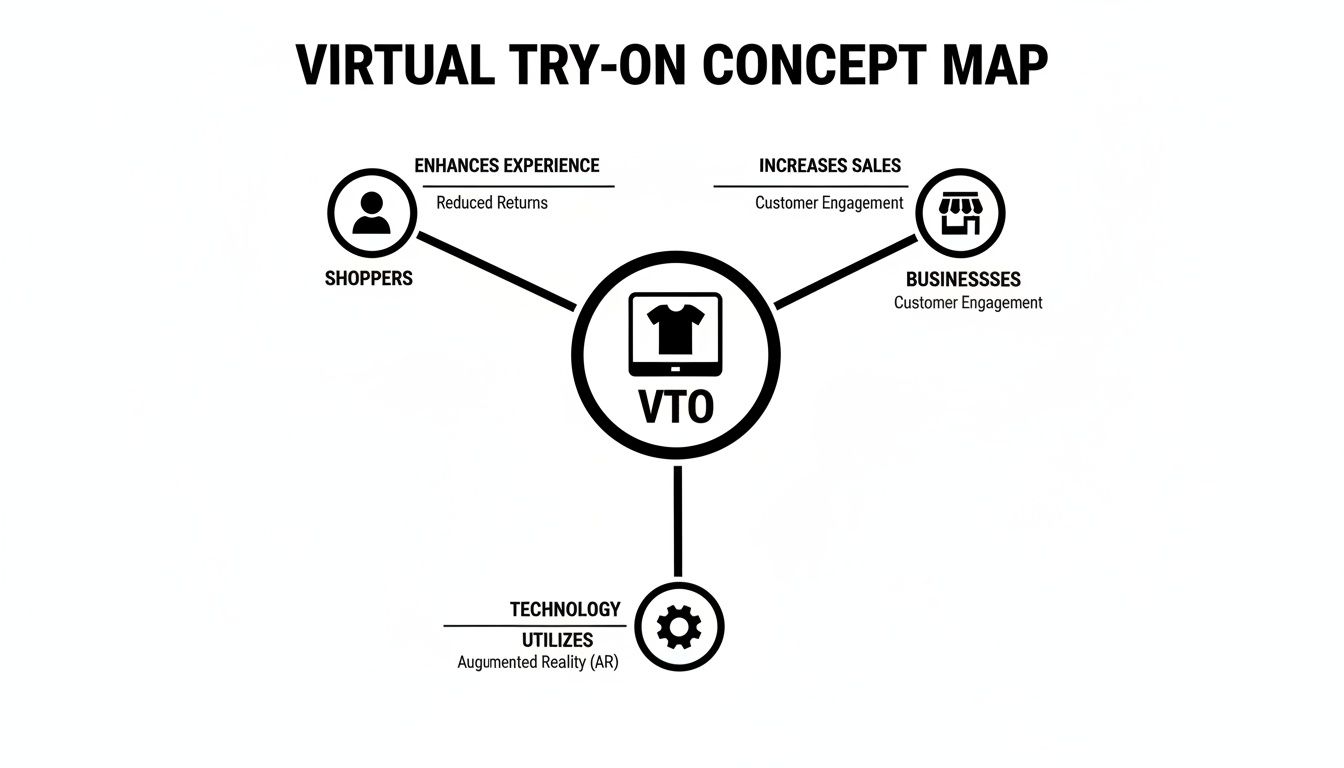
As you can see, it's a feedback loop where smarter tech leads to a better shopping experience, which in turn drives real business results like increased sales.
To make all this possible, these core technologies rely on a handful of other essential tools. The table below breaks down the key players and their roles.
Key Technologies Behind Virtual Try On
A breakdown of the essential technologies that enable virtual try-on and their primary functions in the user experience.
| Technology | Primary Function | Impact on User Experience |
|---|---|---|
| Computer Vision | Analyzes images/video to detect human bodies, faces, and key points. | Enables the system to "see" the user, creating an accurate body map for placing virtual items. |
| 3D Rendering Engines | Generates photorealistic images of the 3D models of clothing and accessories. | Ensures virtual items look real, with accurate lighting, shadows, and textures. |
| Physics Engines | Simulates the physical properties of fabrics (draping, stretching, wrinkling). | Makes virtual clothing move and behave like its real-world counterpart, increasing realism. |
| Cloud Computing | Processes the complex calculations required for AR and AI in real-time. | Provides the necessary horsepower for a smooth, lag-free experience on a user's device. |
Each of these components is crucial for transforming a static product page into an interactive, confidence-building experience.
Creating Lifelike Digital Products
The last, and arguably most foundational, piece of the puzzle is 3D modeling. Before an item can ever be "tried on," it needs to be meticulously recreated as a photorealistic digital twin. This isn’t just a fancy picture; it’s a complete 3D asset that you can spin around, zoom in on, and see from every possible angle.
A high-quality 3D model captures everything from the subtle texture of the fabric to the way light glints off a tiny button. This level of detail is non-negotiable for an immersive experience that helps a customer click "buy" with confidence.
This detailed model is the raw material that the AR and AI systems work with. For a closer look at how businesses are implementing this, it’s worth checking out providers of AR/3D in Ecommerce services.
When you bring it all together, you get a powerful ecosystem. The 3D model provides the lifelike object, AR places it in your world, and AI tailors the fit and movement. This combination is what turns a passive online browser into an active, engaged shopper.
How Virtual Try-On Technology Is Reshaping Ecommerce
Let's be honest: for e-commerce brands, virtual try-on technology can sound like a flashy gimmick. But in reality, it’s one of the most practical tools for growth, tackling some of the biggest, most persistent headaches in online retail. It’s the missing link that closes the gap between a customer casually browsing and confidently hitting the “buy” button.
The most immediate win? Slashing product returns. For any online store, returns are a massive financial drain, eating into profits with shipping, restocking, and processing costs. Virtual try-on hits this problem right where it hurts by giving shoppers a real sense of how an item will actually look on them before it ever leaves the warehouse.
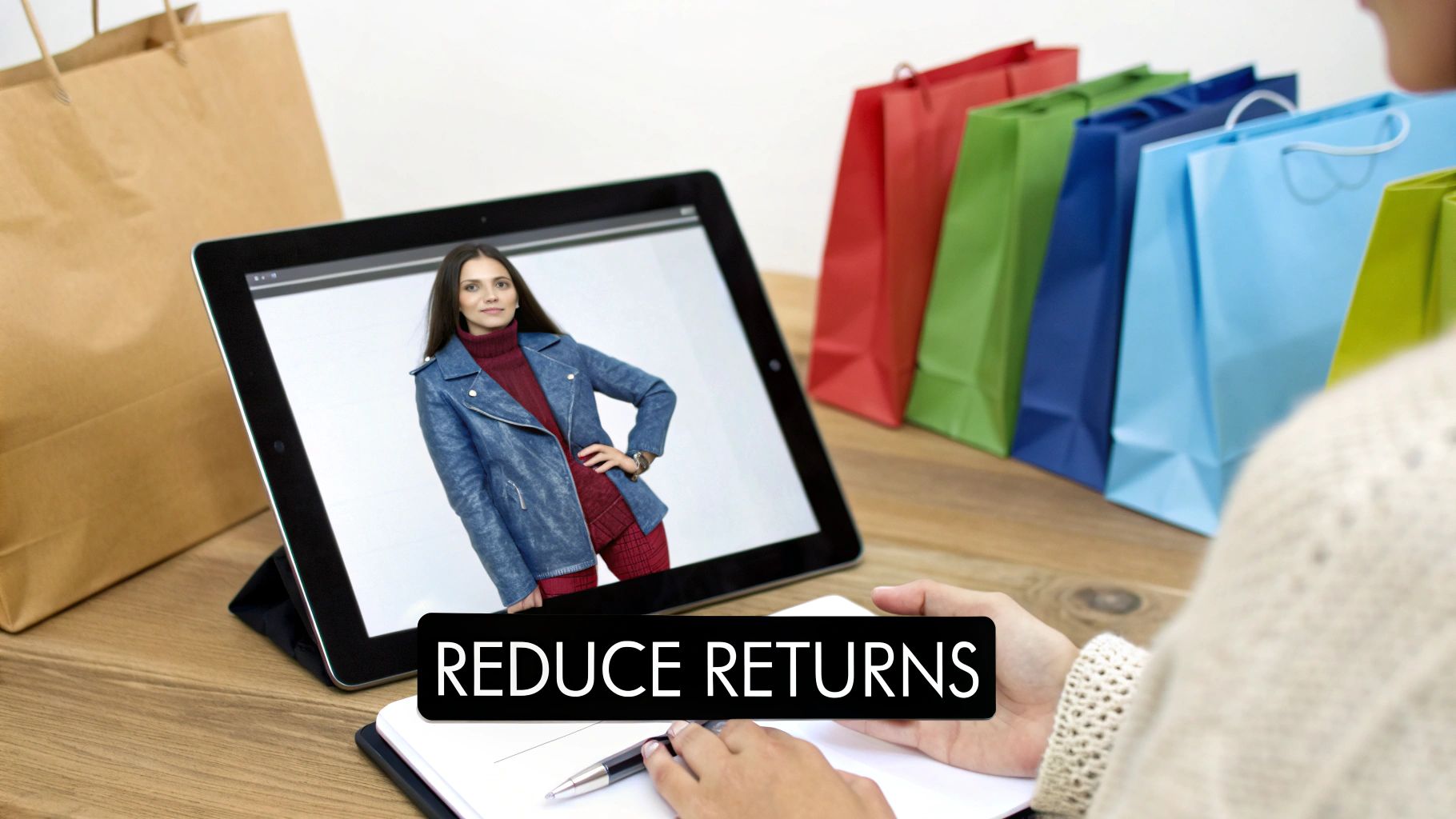
When a customer can virtually "wear" a dress or see how a new pair of glasses frames their face, the chances of a mismatch in style or fit plummet. This isn't just about saving a few bucks; it's about fundamentally improving operational efficiency and boosting your bottom line.
Turning Uncertainty into Sales
Beyond just saving money, virtual try-on is a powerful engine for making it. By erasing that core hesitation—"Will this actually look good on me?"—it gives shoppers a massive confidence boost. That confidence is the magic ingredient that converts a curious browser into a paying customer.
It's not just a hunch. Studies have shown that letting customers interact with products in AR can lead to a 94% higher conversion rate compared to just looking at static photos. When people feel sure about a purchase, they follow through.
This ripple effect touches nearly every key metric. Shoppers who use a virtual try-on feature stick around longer, explore more of your catalog, and build a stronger connection with your brand. It transforms shopping from a simple transaction into an engaging, personalized experience. The market is screaming this from the rooftops: the virtual try-on space is set to explode from USD 10.93 billion to USD 108.5 billion by 2034, fueled by a staggering 25.8% compound annual growth rate. You can see the full virtual try-on market forecast here.
Making Shopping Personal (and Inclusive)
Personalization isn’t a nice-to-have anymore; it's what customers expect. Virtual try-on is one of the most effective ways to deliver it. Instead of guessing how a product on a size-zero model will translate to their body, customers can see it on themselves.
This shift makes the experience far more inclusive and relatable. Shoppers can finally evaluate products based on their own unique body shape, skin tone, and style—a world away from the one-size-fits-all approach of traditional product photography. This is exactly why we built our own virtual try on clothes feature, to let brands generate realistic product shots on diverse models without the logistical nightmare of a physical photoshoot.
When you put it all together, the benefits create a self-reinforcing cycle of growth:
- Fewer Returns: Customers make smarter choices, which means fewer items coming back because of style or fit issues.
- Higher Conversion Rates: More confidence leads directly to more sales. It's that simple.
- Better Customer Engagement: An interactive experience keeps people on your site, deepening their connection to your products.
- Stronger Brand Loyalty: A helpful, personal, and fun shopping journey builds trust and keeps customers coming back for more.
By tackling core e-commerce challenges while elevating the entire customer journey, virtual try-on is doing more than just changing how we shop—it's rewriting the rules of online retail.
Innovative Use Cases Beyond the Online Store
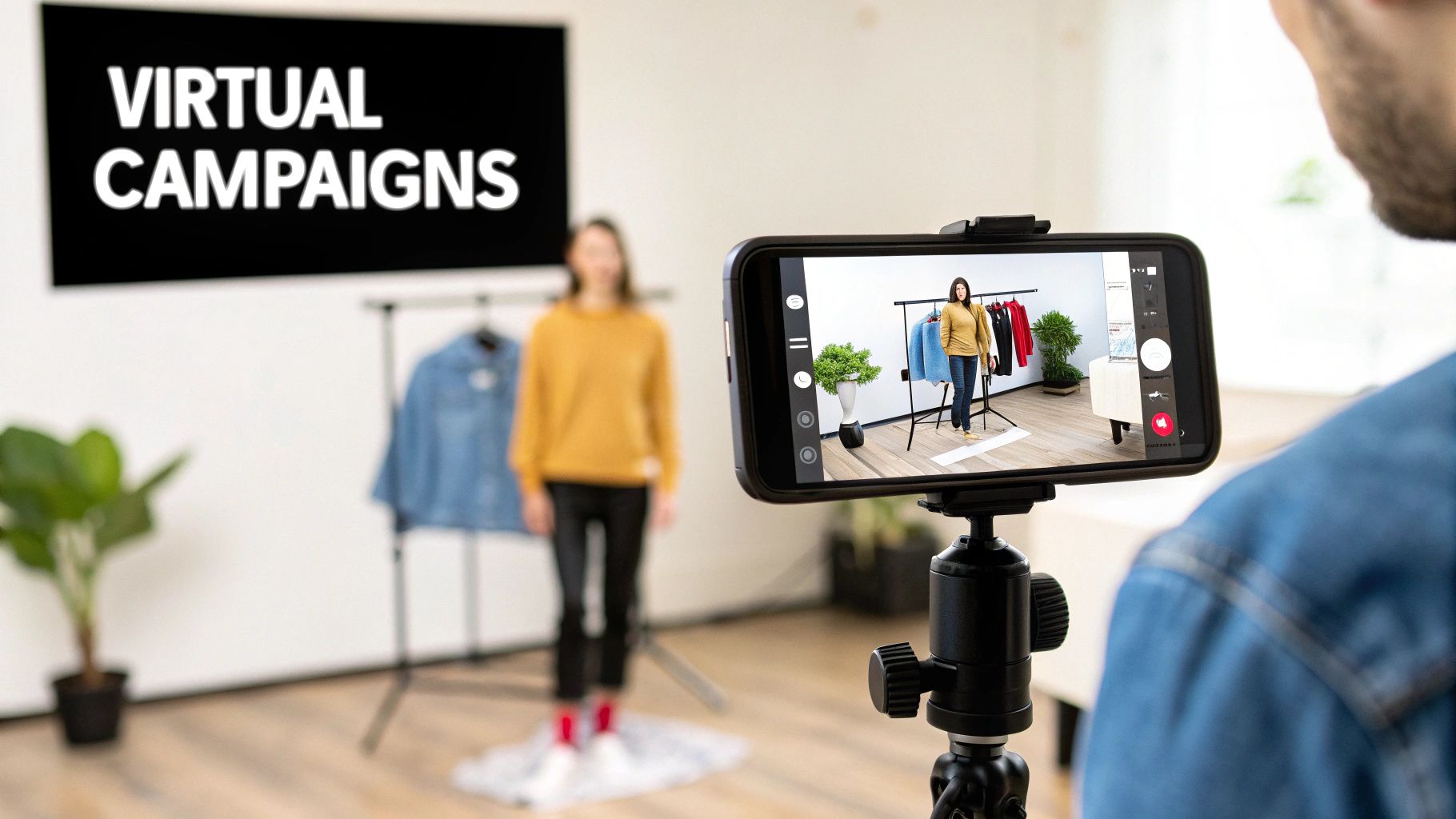
Virtual try-on technology is breaking out of its box. For years, we've thought of it as a simple button on a product page, but that’s just scratching the surface. Savvy marketers and creators are now using it to build incredible brand stories and launch marketing campaigns that were impossible just a few years ago.
This flips the script entirely. VTO is no longer just a reactive tool a customer might use before checkout. It’s now a proactive engine for creating the exact marketing assets you need, capturing attention on social media and ads long before a shopper even lands on your site.
A New Playbook for Social Media and Influencer Marketing
Picture this: your favorite influencer showcases an entire new fashion line without ever touching a single physical garment. This isn't science fiction anymore. AI-powered tools let brands generate hyper-realistic photos and videos of creators "wearing" the latest collection, completely sidestepping the time and cost of traditional photoshoots.
The speed and flexibility are stunning. A brand can cook up content with a dozen different influencers in an afternoon, not weeks, matching specific outfits and styles to each creator's unique vibe. It's a massive advantage for jumping on trends the moment they hit.
Virtual try-on tech lets you create marketing assets at an unbelievable scale. A single product can be shown on countless AI-generated models, representing all body types and demographics, making campaigns both inclusive and razor-sharp.
Using a tool like PhotoAI Studio’s UGC Generator, for example, a brand can churn out authentic-looking user-generated content and product videos. This opens the door to A/B testing different models, backgrounds, and styles to see exactly what clicks with your audience on Instagram or TikTok.
Scaling Up Product Visuals and Advertising
Every marketing agency and in-house brand team fights the same battles: consistency and scale. Traditional photoshoots are a budget-draining, time-consuming mess, and good luck getting the lighting exactly right again six months later. Virtual try-on offers a much cleaner path.
Brands can lock in a consistent visual identity by using the same AI-generated models across every single marketing channel. This ensures every product is shown in the same pose, lighting, and style, hammering home your brand recognition.
It also vaporizes the logistical nightmares of product photography.
- No More Shipping: Forget sending product samples to photographers and models scattered across the globe.
- Endless Variations: Generate countless versions of an image—different backgrounds, model ethnicities, or matching accessories—with just a few clicks.
- Instant Prototypes: See how a new design looks on a real person long before you've even made the first physical sample.
This is a complete game-changer for formalwear brands, too. Companies can set up a virtual suits try on to create incredibly polished marketing assets without the six-figure cost of a high-end studio shoot.
Powering Personalized and Dynamic Content
We're moving beyond static images. This technology is paving the way for truly dynamic ads that feel personal. Imagine seeing an ad that shows a product on a model who actually looks like you. That kind of personalization creates an instant connection and sends engagement through the roof.
For e-commerce, this means you can create personalized lookbooks or email campaigns where every single person sees products modeled in a way that reflects their own body type and style. Suddenly, your marketing feels less like a generic blast and more like a helpful recommendation from a friend.
When you weave virtual try-on technology into your content creation workflow, you stop just selling a product. You start building immersive visual experiences that grab your audience, drive real engagement, and set a new bar for what digital marketing can be.
How to Actually Get Virtual Try-On Working for Your Business
Jumping into virtual try-on doesn't mean you need to hire a team of Silicon Valley engineers or secure a seven-figure budget. A few years ago, that might have been true. Today, there are several ways for businesses of any size to get this technology working, making it more accessible than ever. While a global brand like Nike might build a completely custom solution from the ground up, most businesses can achieve incredible results using specialized SaaS platforms or modern AI tools.
This is a game-changer for e-commerce. A small brand running on Shopify can now offer a sophisticated visual experience that was once the exclusive playground of retail giants. It levels the playing field, giving smaller players a serious tool to build customer confidence and keep shoppers engaged.
Choosing Your Implementation Path
Broadly speaking, you have two main routes to add virtual try-on to your store. Each path has its own trade-offs when it comes to cost, complexity, and how much control you have over the final product.
- Bespoke Development: This is the go-big-or-go-home option. You hire a team of developers to build a unique VTO solution from scratch, perfectly tailored to your products and website. It gives you maximum control but demands a serious investment of time, money, and technical oversight.
- Third-Party Platforms: This is the most practical and popular route by a long shot. You subscribe to a service or use a tool that handles all the heavy lifting—the complex AI and AR processing—for you. This approach is much faster, way more affordable, and doesn't require you to write a single line of code.
For almost every business, that second option hits the sweet spot between power and simplicity. You can get up and running quickly without the massive overhead of a custom development project.
A Practical Approach with Modern AI Tools
This is where platforms like PhotoAI Studio come in, designed to make the whole process dead simple. Forget about lengthy integration projects and API keys. Here, implementation is as easy as uploading a couple of pictures. A fashion brand, for instance, can snap a photo of a model and take a separate, clean shot of a new dress.
The platform's AI then takes over.
As you can see, the interface is clean and gets straight to the point: generating high-quality visuals, fast. The AI intelligently merges the two images, creating a brand-new, photorealistic product shot in just a few minutes. That final image is ready to go straight onto a product page, into an email, or out to a social media campaign.
This method completely sidesteps the biggest technical headaches of traditional virtual try on technology, like 3D modeling and complex AR integration. It cuts right to the chase by producing the most valuable asset—the image of your product on a real person—which is what actually convinces shoppers to click "add to cart."
The demand for these kinds of accessible solutions is exploding globally. The Asia-Pacific region is quickly becoming a major growth engine, with India projected for a massive 21.3% CAGR and China at 16.2% through 2035. This is part of a worldwide trend that’s expected to see the market swell from USD 5.9 billion in 2025 to over USD 22.1 billion by 2035, all driven by brands adopting these user-friendly AI tools.
By embracing these newer, more agile tools, you can add powerful visual marketing firepower to your business with almost no friction. To see how other AI features can fit into your content strategy, check out more articles and guides on the PhotoAI Studio blog.
Measuring Success and Navigating Key Challenges
So, you're thinking about adding virtual try-on to your brand. That's a great first step, but just flipping the switch isn't enough. You need a clear game plan for what success actually looks like and an honest assessment of the bumps you might hit along the way.
To really get a feel for its impact, you have to look beyond a simple bump in sales. A well-executed virtual try-on feature creates a ripple effect, improving the entire shopping experience from discovery to post-purchase satisfaction.
Start by watching the numbers that show how people are actually using the feature. Are conversion rates climbing for products that have the try-on option? That's your first big clue. Also, keep an eye on engagement metrics like average session duration and pages per session. Are people sticking around longer? Digging deeper? But the real money metric is a drop in product return rates. Fewer returns is a direct, undeniable win for your bottom line.
Defining Your Return on Investment
To really nail down the value, you need to calculate your marketing ROI effectively. This isn't just about sales; it's about connecting the cost of the tech to tangible benefits like lower operational costs from returns and happier customers who stick around longer.
The data from big brands paints a pretty compelling picture. Sephora, for example, saw an 11% sales boost with its AR try-on. Warby Parker knocked it out of the park, achieving 85% higher conversion rates among its users. The trend holds across the board: 75% of virtual try-on pilots have lifted customer engagement by 25 points. That’s a clear path to a positive return. If you want to dive deeper into these trends, you can discover more insights on virtual try-on adoption.
The goal isn't just to add a flashy feature. It's to invest in a tool that demonstrably improves the customer experience and strengthens your bottom line. Tracking these specific metrics is the only way to prove that your investment is actually paying off.
Addressing Critical Technical and Ethical Hurdles
While the upside is huge, ignoring the challenges is a recipe for disaster. Getting this right means being prepared to tackle a few key areas head-on to build and keep your customers' trust.
Three big hurdles stand out:
- Technical Accuracy and Realism: Let's be honest—getting photorealism perfect is tough. The tech has to do more than just slap an image on a body; it needs to simulate how a specific fabric drapes and folds. If it's clunky and makes your products look distorted, you're not building trust, you're eroding it.
- Data Privacy Concerns: People are rightfully protective of their data, especially photos and camera access. You have to be crystal clear about how their information is used, stored, and protected. A simple, easy-to-understand privacy policy isn't optional; it's essential.
- Inclusivity and Representation: This is a major pitfall. If your virtual try-on only works well for a narrow range of body types or skin tones, you're alienating a huge portion of your audience. The tool must be inclusive and accurately represent everyone to build an equitable and trustworthy brand experience.
By setting clear goals for what you want to achieve and getting ahead of these challenges, you can truly unlock the power of virtual try-on technology, creating a shopping experience that's both effective and responsible.
A Few Common Questions About Virtual Try-On
As you start picturing how virtual try-on could work for your brand, some questions naturally pop up. Let's tackle the big ones with some straightforward, real-world answers.
How Accurate Is the Clothing Fit, Really?
This is the million-dollar question, and the honest answer is: it depends on the goal. If you want to see how a specific floral pattern drapes, check a color against your model’s skin tone, or just get a vibe for the overall style, today’s VTO is incredibly effective. It's fantastic for answering the question, "How will this look on someone?"
When it comes to nailing a precise fit, things get a bit more complex. Photo-based tools are primarily about visual confidence. They help customers see the garment on a body, which dramatically cuts down on returns from style or color mismatches. For exact sizing, you'd need more advanced systems with 3D body scanning. But for most e-commerce brands, the main win comes from giving shoppers a clear, confident picture of the product's appearance.
Do I Need to Be a Tech Wizard to Use a VTO Tool?
Not at all. This is one of the biggest leaps the technology has made. Platforms like PhotoAI Studio were built from the ground up for marketers, brand owners, and creators—not for software engineers.
The whole point is to make it easy. You upload a picture of a person and a picture of your product. That’s it. The AI does all the heavy lifting behind the scenes, stitching them together into a photorealistic image without you ever having to look at a line of code.
Can This Technology Be Used for More Than Just Clothes?
Absolutely, and this is where it gets really exciting. While fashion gets most of the spotlight, the same core idea—visualizing a product on or in a personal context—works across a ton of different industries.
The tech that puts a shirt on a model is the same kind that powers virtual try-on for:
- Eyeglasses & Sunglasses: Instantly see how different frames suit your face.
- Makeup & Cosmetics: Swipe through lipstick shades or test eyeshadows without a single tester.
- Jewelry: Get a feel for how a necklace hangs or how a pair of earrings will look.
- Furniture & Home Decor: Use augmented reality to place a new couch in your living room to see if it fits.
It shows that virtual try on technology isn't just a niche tool for apparel; it's a powerful way for any brand to close the gap between browsing online and buying with confidence.
Ready to create stunning, high-quality product visuals without the hassle of a traditional photoshoot? With Photo AI Studio, you can generate realistic try-on images in minutes, showcasing your apparel on a diverse range of models. Start creating visuals that convert and reduce returns today. Explore our features and get started.